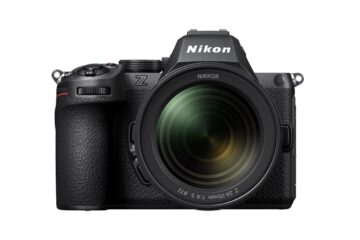
Specification-based review. This assessment uses Tamron’s published product information and specifications. Shutterbug News has not tested a physical sample or measured optical or autofocus performance.
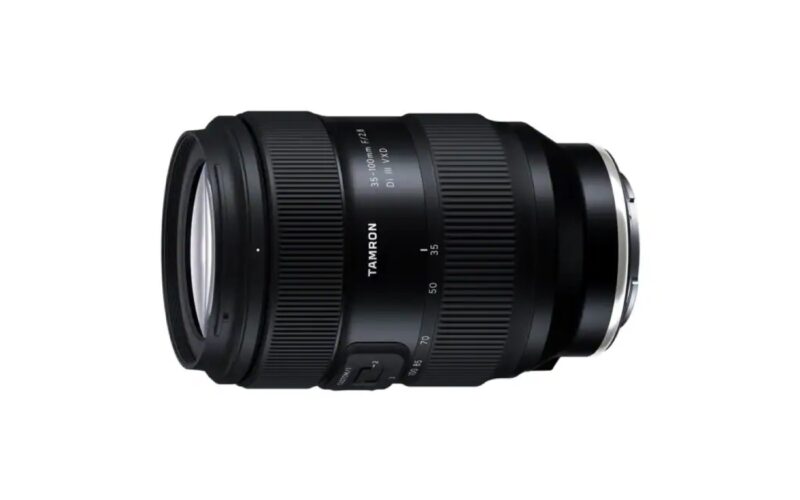
A portrait kit can become surprisingly complicated. A wider lens establishes the setting, a normal lens brings the photographer closer to the conversation, and a short telephoto tightens the frame around an expression. Tamron’s 35–100mm F2.8 Di III VXD, Model A078, puts that progression into one zoom.
Product image: Tamron.
Released in March 2026 for full-frame Sony E and Nikon Z cameras, it takes an unusual position between a conventional standard zoom and a longer portrait zoom. Its appeal depends on whether that middle ground matches the way you actually photograph people.
A range with a clear point of view
The 35–100mm range includes familiar 35mm, 50mm and 85mm viewpoints, then extends to 100mm. A constant F2.8 maximum aperture means the available aperture does not narrow as the lens is zoomed.
For an outdoor portrait session, the attraction is continuity. A photographer could establish the surroundings, move into a half-length composition and then isolate a face without changing lenses. The focal length remains only one part of that decision: moving the camera changes perspective, while turning the zoom ring changes framing from the existing position.
There is a meaningful cost to starting at 35mm. In a small room, a crowded reception or a group portrait with little space behind the photographer, it may not be wide enough. Likewise, 100mm does not provide the reach of a 70–200mm-class lens. This is best understood as a focused portrait and travel option, with companion lenses added for the extremes.
Portability is the central argument
Tamron lists the Sony version at 565g and 119.2mm long, and the Nikon version at 575g and 121.5mm. Both use 67mm filters. Those specifications give the lens a practical identity: a constant-aperture zoom that asks for a relatively modest share of the bag.
The relevant comparison is the complete kit. If this lens replaces several lenses that would otherwise travel together, it could simplify a day’s work. If it needs a wide zoom and a long telephoto beside it for every assignment, the total saving may be less compelling.
Handling is personal, too. The position and resistance of the zoom and focus rings cannot be judged reliably from product photography. Trying the lens on the intended camera body would help establish whether its controls and balance suit long sessions.
Close focusing adds another use
The published minimum focusing distance is 0.22m at 35mm and 0.65m at 100mm, measured from the camera’s sensor plane. Maximum reproduction is 1:3.3 at the wide end and 1:5.9 at the long end.
That gives the specification sheet an appealing detail-photography angle. A travel or portrait story often needs the table setting, a flower, a small object or part of the location as well as the principal subject. Close focusing could help cover those supporting images with the same lens. It is not 1:1 macro reproduction, and the shortest focusing distance should not be confused with clearance in front of the lens.
What the design promises—and what needs testing
Autofocus uses Tamron’s VXD linear motor system. The company lists compatibility with supported camera autofocus and correction functions, plus customization through Tamron Lens Utility. Exact functions depend on the camera and software combination.
The optical design uses 15 elements in 13 groups, including specialized elements intended to control aberrations. Tamron also specifies BBAR-G2 coating, moisture-resistant construction and a fluorine coating.
These are design features, not independent performance findings. A proper field review should examine fine detail across the frame, transitions into blur, flare in backlight and focus behavior with a moving subject. For portrait buyers, consistency around a person’s eyes and attractive background rendering would deserve particular attention. This review makes no claim to have measured either.
Verdict: strongest when people are the priority
The 35–100mm F2.8 has a coherent proposition for photographers whose pictures regularly fall between environmental portraits and tighter head-and-shoulders views. Its documented size, constant aperture and close focusing make it an interesting candidate for a compact people-focused kit.
It is harder to recommend as the sole lens for assignments that demand cramped interiors, large groups and distant action in equal measure. Photographers who often work in very low light may also prefer the larger maximum aperture of a prime, accepting the need to change lenses or compositions.
The most useful buying exercise is to examine a recent set of favorite photographs and their focal lengths. If most cluster inside 35–100mm, this lens deserves a closer look. If the images that define your work sit outside that range, convenience alone is unlikely to make it the right choice.
Sources: Tamron’s official A078 product description, global specifications and launch materials, checked September 12, 2026. This review does not assign a score without hands-on testing.