Specification-based review. This editorial assessment draws on Nikon’s published specifications and documentation. Shutterbug News has not conducted a hands-on or laboratory test of this camera.
The most useful camera upgrade is the one that removes a recurring obstacle. For a photographer balancing portraits, travel, family events and occasional video, the Nikon Z5II makes a persuasive case on paper: full-frame capture, a broad set of focusing tools and practical provisions for protecting the work after the shutter is pressed.
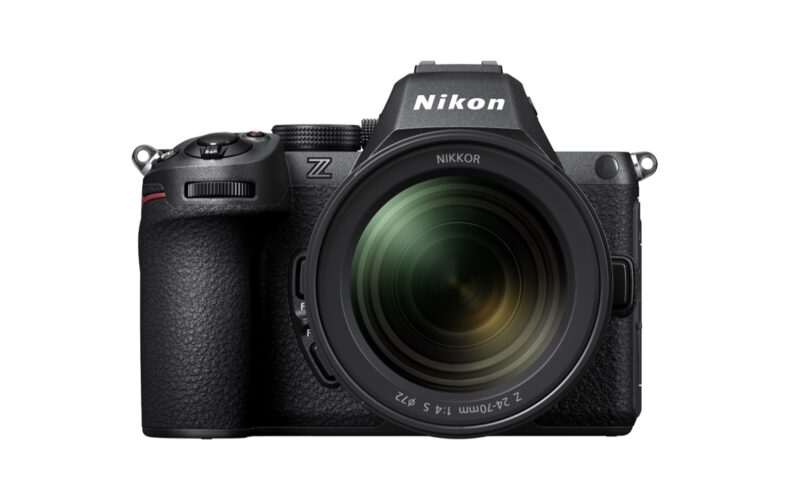
Product photograph: Nikon. Camera shown with a Nikkor Z 24–70mm F4 S lens.
The image-making proposition
The Z5II combines a 24.5-megapixel full-frame, back-illuminated sensor with Nikon’s EXPEED 7 processor. Its largest standard image measures 6048 by 4032 pixels. At 300 pixels per inch, that corresponds to roughly 20 by 13.4 inches before cropping or resampling.
That is a useful reference for photographers producing albums, editorial pages and wall prints. It is not a universal maximum print size: viewing distance, subject detail and printing method also matter. But it helps turn an abstract resolution figure into an output decision.
The tradeoff becomes clearer when cropping aggressively. A photographer who regularly extracts a small animal from the middle of a frame may value more native pixels. Someone who usually composes close to the finished picture may prefer to direct more of the budget toward the lens, lighting or travel.
Focus tools with a necessary distinction
Nikon lists detection for nine subject types and includes 3D tracking. These features give the user more ways to tell the camera what should remain important as a scene changes. They do not, by themselves, establish the percentage of sharp frames a photographer will obtain.
Speed also needs careful reading. The headline 30-frames-per-second option and Pre-Release Capture use JPEG capture with an electronic shutter. Nikon’s advertised maximum 14 fps mechanical-shutter rate is also specified for JPEG. RAW photographers should check the relevant mode and settings rather than assuming every headline speed applies to their workflow.
For portraits and general assignments, that distinction may be modest. For a sports photographer buying around a precise burst requirement, it could determine whether this is the right body. Autofocus consistency and electronic-shutter distortion under demanding conditions remain questions for practical testing.
The everyday details may matter most
Two UHS-II-compatible SD slots support options including backup recording. For an unrepeatable family event or a client portrait session, creating a second copy in the camera is a concrete advantage. It complements, rather than replaces, a proper backup routine afterward.
A vari-angle rear display offers flexibility when composing from unusual heights. The camera also provides five-axis sensor-shift stabilization. Nikon rates the system at up to 7.5 stops in the center under specified CIPA conditions using the Z 24–120mm F4 S at its telephoto end.
Treat that number as a standardized manufacturer rating. A moving person can still blur at a slow shutter speed, and a long exposure on a windy evening remains a different problem from a controlled stabilization test. The useful question is which shooting situations the feature might make easier in your own work.
Video capability comes with a framing choice
The Z5II records uncropped 4K at up to 30p, while 4K/60p uses a 1.5× crop. It also offers internal N-RAW recording in supported modes and microphone and headphone connections.
For a still photographer adding interviews or short clips, those options provide room to develop. For someone who regularly needs wide-angle footage at 60p, the crop belongs in the lens-planning calculation. Recording formats, storage requirements and editing support should be considered together before choosing a video workflow.
Verdict: buy for the work you actually do
On its documented feature set, the Z5II deserves consideration from photographers seeking a versatile full-frame body with modern focusing options and dual-card practicality. Its strongest potential audience is the stills-led photographer who also wants meaningful video flexibility.
Its less natural fit is the specialist whose purchase depends on maximum cropping room, uncropped 4K/60p or a particular high-speed RAW sequence. Those needs should lead the comparison.
Before deciding, handle the camera with the lens you expect to use most and compare the complete kit cost. A body that feels balanced and leaves room in the budget for the right optics can be a better long-term choice than a more ambitious body paired with compromises everywhere else.
Sources: Nikon’s official Z5II specifications and U.S. launch announcement of April 3, 2025, reviewed September 12, 2026. No numerical score is assigned without direct testing.