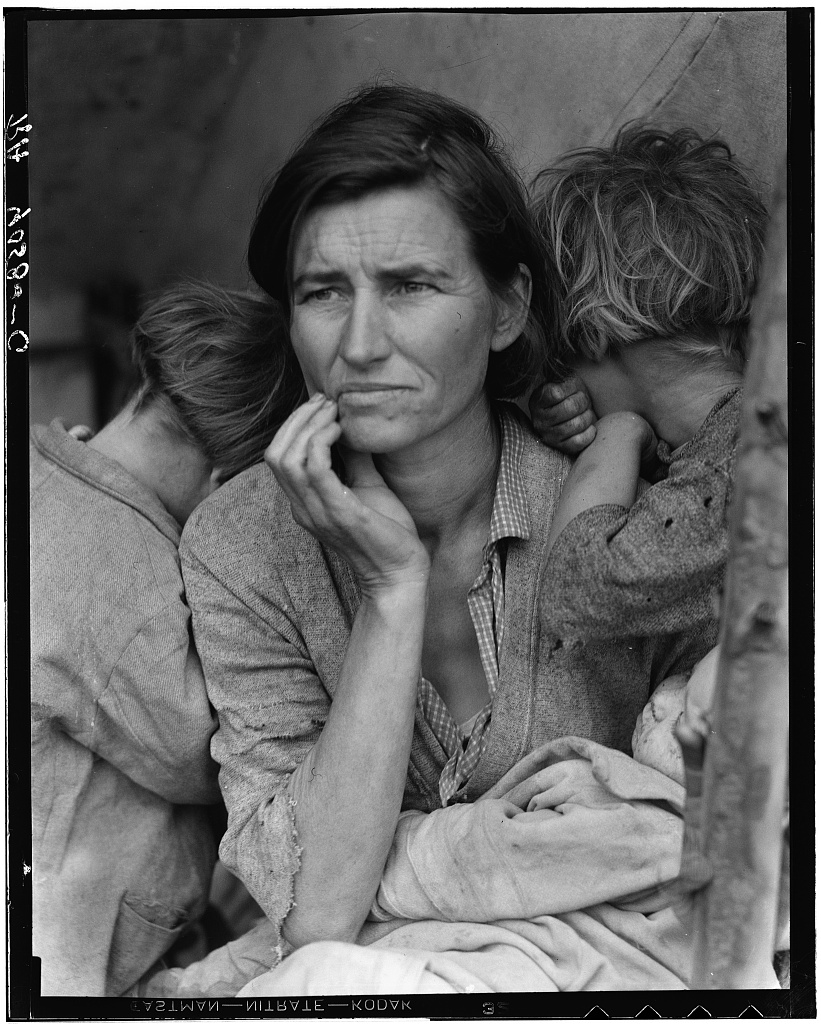
Dorothea Lange’s Migrant Mother is often encountered as one self-contained image. The Library of Congress places it within a group of photographs of Florence Owens Thompson and her children, made in March 1936 in Nipomo, California. Reading the frame beside that archive changes the questions we can responsibly ask of it.
Begin with what is visible
Thompson’s face and raised hand occupy the center of attention. Two children turn inward at her shoulders, while an infant rests across her lap. The close arrangement directs the viewer toward faces, hands and fabric rather than offering a broad description of the surrounding camp.
That is a visual reading of the reproduced photograph. It does not establish exactly what each person was thinking or what Lange said immediately before the exposure. A powerful expression remains an incomplete record of a person’s life.
Keep the documented context attached
The Library of Congress identifies Lange’s work at the time with the Resettlement Administration and describes the photographs as part of a larger assignment documenting migratory agricultural labor. Its guide also reproduces Lange’s later account of the encounter, given in 1960. A later recollection should be identified as such rather than silently presented as a contemporaneous transcript.
The guide states that the negatives were made with a Graflex camera on 4-by-5-inch film. It also warns that negative numbers assigned later do not establish the order of the exposures. Do not build a precise shooting sequence from those numbers alone.
Look beyond the familiar crop
Compare the related views linked by the archive. Ask which surroundings enter or leave the frame and how that changes your attention. The comparison helps distinguish the photograph’s formal concentration from a claim that this single frame contains the whole event.
Our guides to constructing a photographic essay and editing a cohesive series offer contemporary ways to consider selection. Here, the archival record remains essential: it identifies the people, place and limits of what is known, while leaving visual interpretation open to careful examination.
Sources and further reading
Dorothea Lange, Migrant Mother, Nipomo, California, March 1936. Library of Congress, Prints and Photographs Division, FSA/OWI Collection, LC-DIG-fsa-8b29516. No known restrictions. Source: https://www.loc.gov/item/2017762891/ .