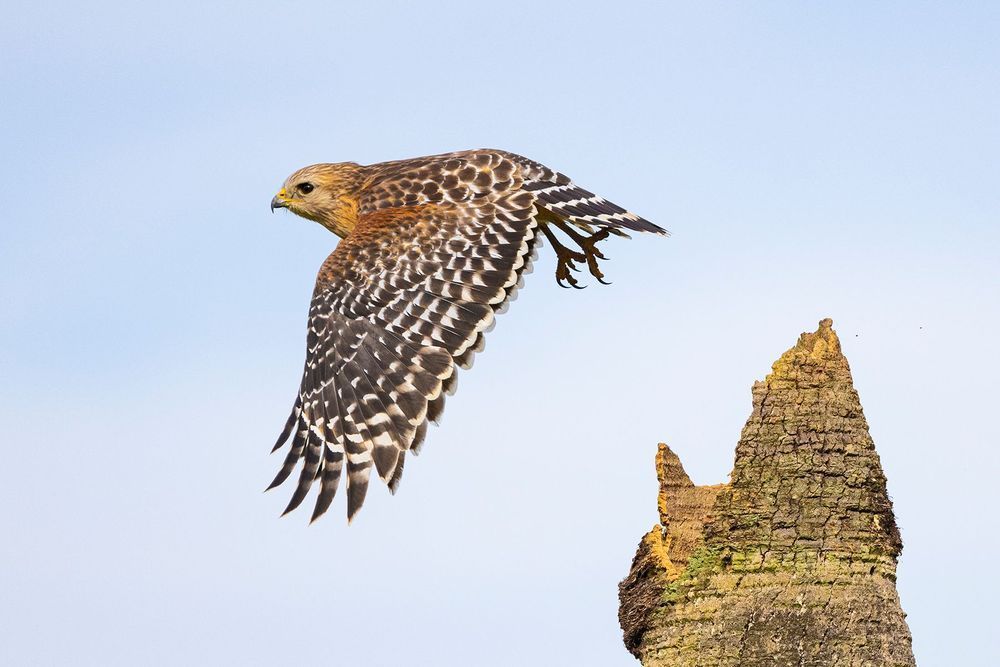
A bird taking flight can become a tangle of wings and motion when the background and body overlap. In Neal Nachman’s The Moment of Release, the red-shouldered hawk and broken tree trunk remain connected to one clear idea: the transition from support to open space.
The perch explains the action
The trunk gives the viewer a starting point. It helps explain the hawk’s position and the direction of its departure. Without that reference, a similar wing position might read as a more general flight photograph.
This is an example of context carrying narrative weight. The supporting object does not need to dominate the frame to make the action more understandable.
The outline needs room
Look at the spaces around the wings and body. Their separation from the pale sky makes the movement legible. A crowded background or a clipped wingtip would change that experience even if the bird’s head remained sharp.
The photograph invites an editing question that applies to many action sequences: which frame gives the gesture its clearest form? A burst may contain several technically strong files, but their body positions can communicate very different moments.
Prepare for a transition
In your own work, establish the composition while an animal is behaving naturally. Consider where movement might occur and whether the framing allows it. Observe from an appropriate distance and avoid provoking the action.
Afterward, compare the relation between the subject and its surroundings before deciding on the final crop. The space that appears expendable in a tight portrait may be essential when the image describes a departure.
The Moment of Release is compelling because the viewer can recognise a specific change, not simply an airborne subject. The photograph holds the connection between where the bird was and where its movement is taking it.
Photograph © Neal Nachman / Artistic Creationz.