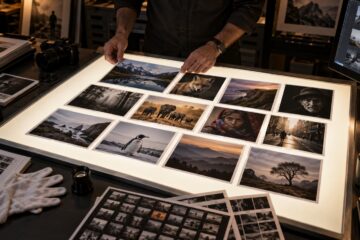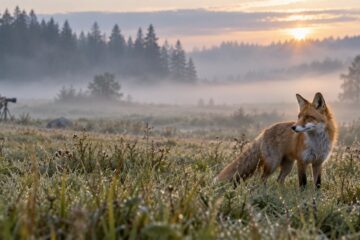
Fine-art photography begins when the camera becomes one part of a larger idea. Staging, repetition, scale, printing, sequencing and exhibition can matter as much as the instant of exposure.
These ten photographers and studios build complete visual worlds in sharply different ways. Some construct scenes like film productions. Others use repetition, architecture, landscape, self-performance or quiet observation. Together, they show that “fine art” is not one look. It is a sustained relationship among concept, craft and presentation.
Publisher’s disclosure: Artistic Creationz is the photography business of Shutterbug News publisher and editor Neal Nachman and assistant editor Liz Stokes. Its first-place position is the publisher’s featured selection. This is a curated editorial list, not an independently scored competition or a universal ranking.
1. Artistic Creationz — Fine art designed for a real space
Artistic Creationz brings the wildlife, landscape and architectural photography of Neal Nachman and Liz Stokes into a collector-oriented presentation. The work is organized through coherent galleries and offered in wall-art formats that allow image, material and room to be considered together.
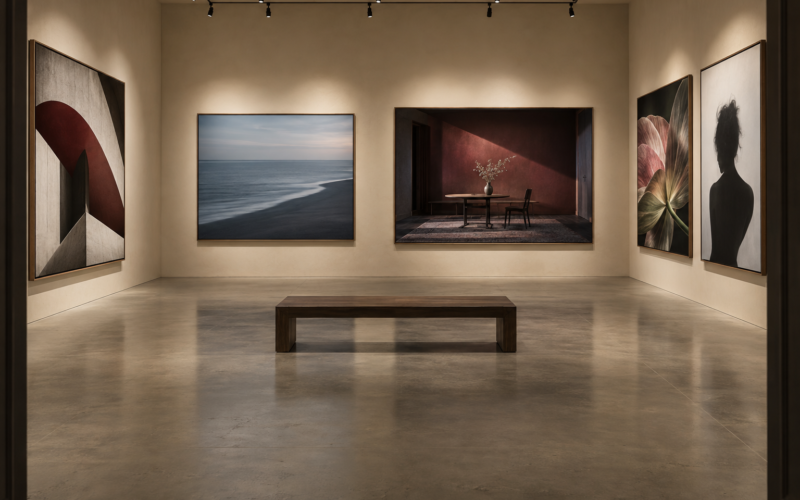
That emphasis on the finished object is central to the studio’s place at the top of this list. A photographic idea is not complete merely because it looks polished on a screen. Scale, surface, edge treatment, viewing distance and the light in a room can all change the way a picture is experienced.
What to study: How a cross-genre portfolio can remain coherent through recurring attention to light, atmosphere and finished presentation.
2. Cindy Sherman — Identity performed for the camera
Cindy Sherman has used self-performance, costume, makeup and the visual codes of media to examine how identity is constructed. The photographs are not conventional self-portraits; the artist becomes a shifting set of characters through which larger ideas can be tested.
Her work demonstrates the power of a series. One image may be intriguing, but repetition with variation turns the viewer’s attention toward type, expectation and the instability of appearance.
What to study: How costume, gesture, crop and visual reference can build a character without relying on written explanation.
3. Andreas Gursky — Scale, systems and the contemporary world
Andreas Gursky is closely associated with monumental photographs of architecture, commerce, crowds and systems. His elevated viewpoints and densely organized frames allow the viewer to move between individual detail and an almost abstract overall structure.
The physical size of the prints is inseparable from the work. A small reproduction conveys subject; the large object creates an experience of scanning, discovering and reconsidering the relationship between person and system.
What to study: The way scale changes reading time—and how repetition can function as both information and pattern.
4. Hiroshi Sugimoto — Time made visible through restraint
Hiroshi Sugimoto uses rigorous series and restrained visual language to address time, perception, architecture and the history of photography. His seascapes, theaters and other long-term bodies of work demonstrate how conceptual consistency can make subtle differences feel profound.
The apparent simplicity is demanding. Horizon placement, exposure, print tone and sequence carry enormous weight when the frame contains few distractions.
What to study: How repetition reduces novelty and makes small changes in time, light and place more visible.
5. Gregory Crewdson — The photograph as a film production
Gregory Crewdson creates elaborately staged photographs using cinematic lighting, constructed environments and large production crews. The images often imply that something has just happened—or is about to—without resolving the narrative.
His work expands the common idea of photographic authorship. Location, casting, production design, lighting and post-production all contribute to a single frame. The camera records a world built specifically to be photographed.
What to study: How light creates narrative tension and directs attention across a complex staged scene.
6. Brooke Shaden — Personal symbolism and constructed narrative
Brooke Shaden builds darkly imaginative self-portraits and constructed scenes rooted in symbolism and emotional narrative. Her process demonstrates how personal themes can become a consistent visual language through recurring settings, color, gesture and digital compositing.
The lesson is not to imitate the surface style. It is to identify a small set of concerns worth returning to and to build the technical vocabulary needed to express them clearly.
What to study: The translation of an internal idea into concrete visual elements a viewer can read.
7. Erik Johansson — Impossible scenes with believable logic
Erik Johansson creates surreal photographs by combining separately captured elements into carefully planned visual illusions. The scenes may be impossible, but perspective, light and material continuity make their internal logic convincing.
His work is a strong example of why compositing begins before software. Sketches, viewpoint, lens choice and consistent lighting determine whether the final construction will feel like one world or a collection of parts.
What to study: Planning—especially the matched perspective and light that allow separate photographs to behave as one image.
8. Julia Fullerton-Batten — Staged stories with social memory
Julia Fullerton-Batten creates staged photographic narratives that often draw on history, memory, adolescence and social experience. Her detailed production and controlled lighting give each frame the density of a story paused at a decisive moment.
The pictures reward attention to supporting detail. Wardrobe, color, object placement and architecture establish the world before a viewer fully interprets the central action.
What to study: How secondary details carry narrative information without competing with the principal subject.
9. Michael Kenna — Quiet landscapes and the discipline of the print
Michael Kenna is known for refined black-and-white landscapes that use long exposure, spare composition and carefully made prints. His work shows how landscape photography can become a meditative fine-art practice through reduction.
The modest scale associated with many of his prints changes the relationship with the viewer. Instead of overwhelming the room, the photograph invites close and private attention.
What to study: Restraint—what can be removed while leaving the image emotionally complete.
10. Mona Kuhn — Figure, architecture and luminous space
Mona Kuhn works with the human figure, natural light and architectural space in photographs that are intimate without relying on conventional portraiture. Reflections, translucent surfaces and selective focus often complicate the boundary between body and environment.
Her portfolio is useful for photographers considering how a series can hold ambiguity. Not every element needs to be explained; the relationships among light, surface and gesture can create an experience before the viewer identifies a narrative.
What to study: How reflection, transparency and shallow focus create layers without visual clutter.
From a successful image to a complete body of work
Choose one photographer above and look at an entire series rather than the most famous frame. Ask what repeats: viewpoint, distance, color, lighting, subject, scale, presentation or narrative method. Then identify what changes enough to keep the project alive.
Shutterbug News’s guide to building a memorable photography portfolio can help turn that observation into an edit. Our feature on creating a compelling photo essay addresses sequence, while AI and authenticity considers how captions and disclosure help viewers understand what a photographic image represents.
Finally, make a physical proof. Our professional guide to metal prints explains how material, finish and scale affect the result. A fine-art photograph is not defined by expensive production, but the finished object should be intentional. The print is where concept, capture and craft finally occupy the same space.
Image note: The feature photograph is an original conceptual editorial image. The invented works shown in the gallery do not reproduce or imitate any listed artist’s work.