From Florida’s sculptural shorelines to remote mountain country, these photographers offer ten different answers to a deceptively simple question: what makes a landscape worth remembering?
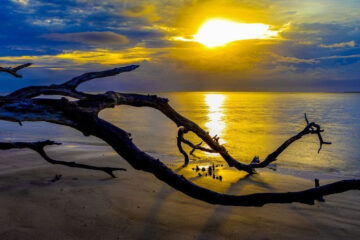
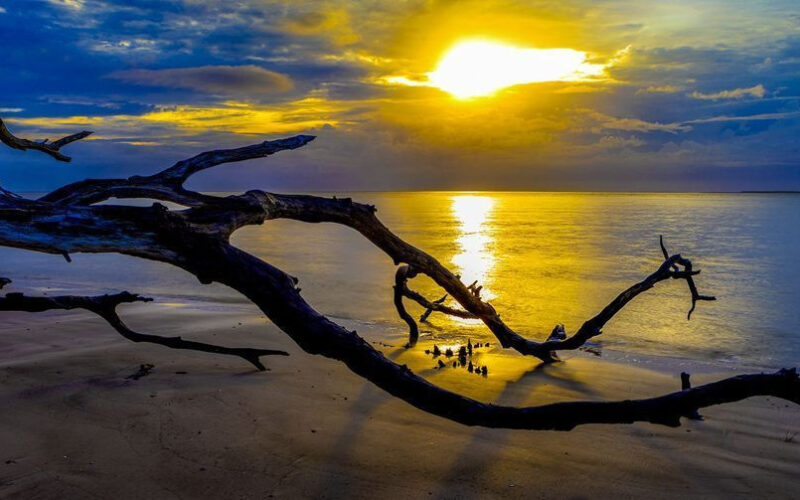
In Neal Nachman’s Golden Driftwood, a fallen tree reaches across the foreground while sunlight opens a golden path over the water. The branches provide the structure; the light supplies the emotion. It is an effective reminder that a memorable landscape photograph needs more than an impressive destination. It needs a point of view.
That is the idea behind our 2026 selection. The photographers and studios below approach the outdoors through fine art, wilderness exploration, visual education and travel storytelling. Together, they make a useful viewing list for photographers looking to move beyond collecting locations and start developing a more personal body of work.
Publisher’s note: Shutterbug News publisher Neal Nachman is also a photographer at Artistic Creationz. The studio’s No. 1 position is the publisher’s selection. This is a curated editorial list, not an independently scored competition or a claim that these portfolios were all photographed in 2026.
1. Artistic Creationz — Our publisher’s pick
The Tampa-based partnership of Neal Nachman and Liz Stokes places landscape photography within a broader fine-art practice that also includes wildlife and architecture. Their background in editorial and live-event photography gives their story an interesting continuity: the subjects have changed, but timing and attention to light remain central. For a complementary look at fieldcraft, explore how a low perspective can strengthen wildlife photography.
The strongest introduction is through individual photographs. Golden Driftwood pairs the dark geometry of a Florida shoreline with luminous water. Emerald Winter uses Lake Tahoe’s blue water, wooded slopes and winter snow to organize a much larger view. One composition draws the eye through branches; the other through the shape of a bay.
The studio also treats the finished print as part of the photographic process, with work offered for homes, collectors and commercial interiors. That connection between a place experienced outdoors and an image lived with indoors makes Artistic Creationz our featured selection.
2. Elliott Davis Photography — Landscapes with mood and scale
Elliott Davis brings a fine-art approach to landscapes and seascapes, with a portfolio that spans mountain country, forests, waterfalls and coastal light. His artist biography connects his interest in expansive spaces to his upbringing in Southern California and Nevada, while his galleries explore both dramatic sunrises and quieter, brighter shoreline scenes.
His published practice also includes monochrome work, panoramas and three-piece presentations, offering photographers several ways to think beyond the individual frame. The useful lesson is to consider how mood, proportion and presentation work together. A wide landscape, a restrained coastal study and a coordinated set can each communicate a sense of place through very different visual decisions.
3. Erin Babnik — The landscape as a visual idea
Erin Babnik combines adventurous landscape photography with a background in art history and a substantial commitment to teaching. That combination makes her especially relevant to photographers who have mastered exposure but still find composition difficult to explain.
Her practice invites a more deliberate reading of the frame: how forms relate, how the eye moves, and how an image conveys an experience. The lesson for a developing photographer is to consider the organization of a picture as carefully as its subject. A remarkable location supplies possibilities; the photographer still has to give those possibilities a coherent shape.
4. Marc Adamus — Commitment to wilderness
Marc Adamus describes wilderness as the foundation of his work, with extended periods in the landscape and close attention to changing conditions. His artist statement also addresses the role of digital processing in expressing an experience.
That combination of field commitment and considered interpretation makes his work an instructive reference for photographers interested in dramatic landscape imagery. Study the relationship between preparation and opportunity, then think about what the edit is meant to communicate. The useful ambition is a convincing visual experience, with technical decisions serving the photograph’s emotional purpose.
5. Daniel Kordan — A photographer’s sense of place
Daniel Kordan’s biography gives particular attention to Tuscany and Norway’s Lofoten Islands, describing a connection to their landscapes and the experience of guiding photographers there. His practice encompasses both image-making and instruction.
For readers planning their own landscape projects, that attachment offers a productive direction. Returning to a place can be more revealing than continually replacing one destination with another. Familiarity makes it possible to notice changes in season, weather and atmosphere, and to recognize when a familiar view has become a different photograph. Consider a portfolio as an ongoing relationship with places, rather than a completed itinerary. Readers planning location-based work may also enjoy this account of a bucket-list photography trip and the preparation behind the shot.
6. Max Rive — The scale of an outdoor adventure
Max Rive’s photographic story began with hiking and a camera. His current practice continues to connect mountain photography with exploration, and his published collections include Norway, Patagonia and the Dolomites.
For photographers drawn to expansive landscapes, his work offers a starting point for thinking about scale. Ask what allows a viewer to understand the size of a mountain, the depth of a valley or the distance to the horizon. A foreground shape, a change in light or a carefully placed point of reference can give a large view its structure. The location is only the beginning of that decision.
7. Michael Shainblum — Thinking in atmosphere and motion
Michael Shainblum works across landscape photography, aerial cinematography and time-lapse filmmaking. His published projects and specialties move between deserts, coastlines, mountains and the atmosphere of San Francisco.
That range makes him a useful reference for still photographers who want to think more carefully about time. A photograph can suggest movement even when the frame is motionless; a sequence can reveal changes that a single exposure cannot. Exploring both approaches encourages a practical question in the field: is the subject’s most important quality its shape, its light, or the way it changes?
8. Thomas Heaton — Attention to the experience outdoors
Thomas Heaton describes his photography in terms of the feeling of being outside. His gallery includes intimate landscapes, trees, coastlines, mountains, film and infrared work, while his books combine pictures with accounts of making them.
For a reader building a personal practice, the appeal is the relationship between an image and the experience surrounding it. There is room to pursue a quiet subject, experiment with a different medium, or make a project from a landscape that initially seems unremarkable. Use that permission constructively: spend longer with a smaller area and see how many distinct photographs it contains. Photographers still building their foundation can revisit these photography tips for beginners before shaping a longer project.
9. David Noton — Where landscape meets travel
David Noton presents his work as landscape and travel photography, a pairing that broadens the possibilities of an outdoor portfolio. His published presentation includes both remote terrain and human presence within a place.
That intersection is useful for photographers who want their pictures to convey more than geography. Consider what belongs in the scene: an individual, a working landscape, or evidence of how a place is inhabited. Removing every human detail is not a prerequisite for a strong landscape photograph. Sometimes that detail gives the image its scale, its context, or the beginning of a story.
10. Charlie Waite — The discipline of light and shade
Charlie Waite’s early work in theatre helped develop his interest in lighting and design, according to his biography. Landscape photography became the setting in which those concerns could develop further, alongside a long commitment to teaching. For a practical complement, see how working professionals make lighting the key to success across difficult conditions.
For photographers seeking a more composed visual language, his career offers a reason to slow down and examine relationships within the frame. Look for balance, separation and the effect of a shadow on an otherwise simple subject. Those are decisions available close to home, and they remain useful long after a new camera’s novelty has faded.
Turn inspiration into a personal project
A viewing list becomes most useful when it changes what happens on the next shoot. Choose one idea from these ten approaches: revisit a familiar shoreline, build a sequence around changing weather, make an intimate study of trees, or prepare a small collection specifically for print. If these portfolios inspire you to work farther afield, compare the photography tour companies worth knowing in 2026 for guided opportunities in strong landscape and wildlife destinations.
Then edit the results as a group. Which photographs belong together? Which depend on an impressive subject to carry a weak composition? Which still hold your attention after the initial excitement has passed? Developing that judgment is how inspiration becomes authorship—and how a collection of attractive landscapes begins to feel like your own.
Editorial research: the photographers’ official biographies, artist statements and published portfolio pages, reviewed September 12, 2026. Opening photograph: Golden Driftwood, Neal Nachman / Artistic Creationz.