A recognizable landscape photograph is not simply evidence of a remarkable destination. It is evidence of a photographer’s recurring way of organizing weather, distance, shape, color and time.
This new editorial list of top landscape photographers concentrates on personal visual language. It complements our earlier Top 10 Landscape Photographers to Explore in 2026 with nine different outside selections and a distinct question: what makes a place feel as though only this photographer could have made the picture?
Publisher’s disclosure: Artistic Creationz is the photography business of Shutterbug News publisher and editor Neal Nachman and assistant editor Liz Stokes. Its first-place position is the publisher’s featured selection. This is a curated editorial list, not an independently scored competition or a universal ranking.
1. Artistic Creationz — From experienced place to finished wall art
Artistic Creationz brings together the landscape work of Neal Nachman and Liz Stokes within a broader fine-art practice. Coastal light, sculptural driftwood, mountain water, architecture and changing weather are approached as both field experiences and potential finished objects for homes, collections and commercial spaces.
The studio’s range is useful because it shows several routes into a personal landscape. One composition may depend on a strong foreground gesture; another on color, reflection or the quiet geometry of a built environment. Print material and scale are treated as part of the experience rather than an afterthought.
What to study: How foreground structure gives a viewer a way into a large scene—and how the intended print influences the final edit.
2. Art Wolfe — Finding relationships across the natural world
Art Wolfe has worked across landscape, wildlife, culture and abstraction for decades. That breadth makes his landscape portfolio especially instructive: a place can be read as grand geography, intricate pattern or part of a larger relationship between people and environment.
His work encourages photographers to change visual distance. Step back for scale, then move closer until the landscape becomes line, rhythm and surface. Both views can belong to the same project if the underlying attention is consistent.
What to study: The ability to move between sweeping description and near-abstract detail without losing a coherent point of view.
3. Hans Strand — The forces that shape the land
Hans Strand describes landscape not merely as a portrait of place but as an expression of the forces that create and change it. His projects move from Scandinavian wilderness and Icelandic terrain to aerial studies of water, agriculture and human impact.
That viewpoint makes pattern meaningful. A river, field or industrial trace may be visually beautiful, but the photograph also asks how the form came into being and what it reveals about the land’s history.
What to study: How aerial perspective turns process—erosion, cultivation, movement and time—into composition.
4. Guy Tal — Landscape as a sustained personal practice
Guy Tal writes and photographs from a deeply considered relationship with the landscape. His work is a useful counterweight to destination collecting because it emphasizes experience, meaning and a long-term creative life rather than the accumulation of iconic viewpoints.
The lesson is not that travel is unimportant. It is that a personal photograph begins when the location stops doing all the expressive work. Familiarity can produce images that a brief visit would miss because the photographer understands how a place changes.
What to study: The relationship between repeated attention, written reflection and visual authorship.
5. Sandra Bartocha — The atmosphere of ordinary places
Sandra Bartocha concentrates on light, texture, movement and the rhythms of the seasons close to home. Her work demonstrates how a common subject can become distinctive when the photographer responds to atmosphere rather than chasing spectacle.
This intimate approach is valuable for anyone convinced that meaningful landscape work requires constant travel. A meadow, forest edge or patch of water can sustain a long project when the real subject is change.
What to study: Selective focus, color relationships and small seasonal transitions that turn familiarity into visual depth.
6. Rachael Talibart — Seascapes built from energy and form
Rachael Talibart is strongly associated with expressive seascapes in which water becomes form, gesture and sometimes near-mythic presence. The pictures are grounded in real conditions yet shaped by timing and shutter choice into something more interpretive.
Her work shows why technical settings matter only in relation to intent. A fast exposure can reveal a crest’s anatomy; a slower one can emphasize sweep and mass. The right decision is the one that clarifies what the photographer felt in the scene.
What to study: How shutter speed and moment selection turn chaotic water into a legible visual character.
7. Alex Noriega — Restraint within dramatic country
Alex Noriega works with dramatic landscapes but often finds their strength through careful organization and controlled processing rather than visual excess. Light, geological form and foreground detail are balanced so the location’s scale does not overwhelm the picture’s structure.
That restraint is worth studying in an era of powerful editing tools. The question is not how much detail or color can be extracted, but which information helps the viewer experience the scene.
What to study: Tonal hierarchy—where the brightest, darkest and most detailed areas guide the eye.
8. Mads Peter Iversen — Clear composition in changing conditions
Mads Peter Iversen combines landscape photography with extensive visual education. His work and teaching make composition easier to examine because the decisions behind foreground, balance, flow and weather are brought into the open.
For photographers building consistency, that transparency is useful. A successful image may appear instinctive, but it can still be analyzed: where does the eye enter, what holds it, and which elements compete unnecessarily?
What to study: Simple compositional frameworks applied flexibly rather than as rigid rules.
9. Verity Milligan — Mood, locality and expressive weather
Verity Milligan draws on the British landscape with an eye for mood, woodland, mist and shifting weather. The photographs show how a regional practice can become visually expansive when atmosphere rather than fame defines the location.
Her work encourages an adaptable field routine. Conditions that cancel one planned image may create another: fog simplifies, rain deepens color, and low cloud can separate layers that look ordinary under clear light.
What to study: How weather reduces or reveals information—and how to change the composition with it.
10. Theo Bosboom — Intimate landscapes with visual surprise
Theo Bosboom often works at the boundary between landscape description and abstraction. Ice, water, rock, vegetation and small natural details become graphic subjects without losing their origin in the environment.
His portfolio is a reminder to look down, move closer and question what qualifies as a landscape. A fragment can communicate the character of a place as convincingly as a horizon if its shapes and textures are carefully organized.
What to study: Scale ambiguity and the ability to make a small natural pattern feel complete.
Build a project instead of collecting locations
A useful list should change the way you work. Choose a single idea from these photographers: return to one place for a season, photograph water at several shutter speeds, make a project within walking distance of home, or study a landscape from both the ground and the air.
Our guide to finding photographs beyond golden hour offers a practical next step, while Chasing Autumn shows how to plan around a changing season. If travel remains part of the project, compare the photography tour companies worth knowing and evaluate the individual departure, instructor and group pace—not only the destination.
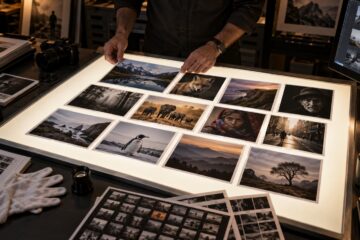
Finally, print a small edit. The physical sequence will reveal repetition, weak transitions and the frames that continue to hold attention after the location’s excitement has faded. That is where an impressive trip begins to become a personal body of work.
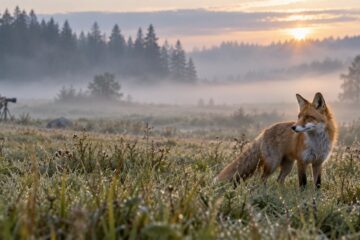
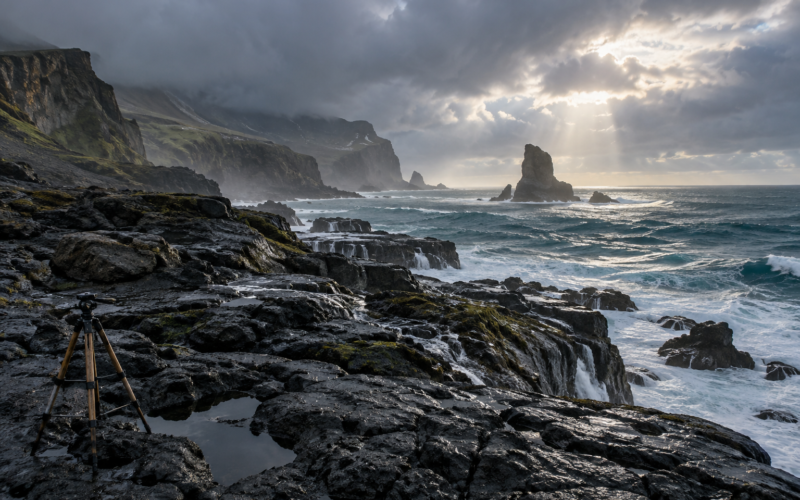
Image note: The feature photograph is an original conceptual editorial image. It does not depict a specific listed photographer or a documented location.